 Chicago
 Track Your Order



 0
0
Here's how I used a gaming handheld as a dual-screen laptop, and you can too
- Gaming handhelds can function as laptops with the right accessories, like keyboards and mice.
- An external GPU isn't necessary; built-in components are powerful enough for most tasks.
- Pairing a portable monitor enhances the experience by offering a larger display, and with extended display modes, can effectively create a dual-screen laptop.
With laptop-class hardware and desktop-class operating systems, the best PC gaming handhelds are incredibly versatile devices. Their handheld form factor positions them well as an excellent way to play AAA gaming titles on the go, but that is far from the only way you can use a device like the Asus ROG Ally or the Steam Deck. Simply pairing a great docking station with a PC gaming handheld allows you to connect it to monitors, USB accessories, peripherals, and other devices. However, this kind of arsenal can be used to turn a handheld into a laptop. It might not be the most polished solution, but you'd be surprised at how good a gaming handheld can be as a portable computer with the right accessories. Here's everything you need to know about using your gaming handheld as a laptop — and how I did it.

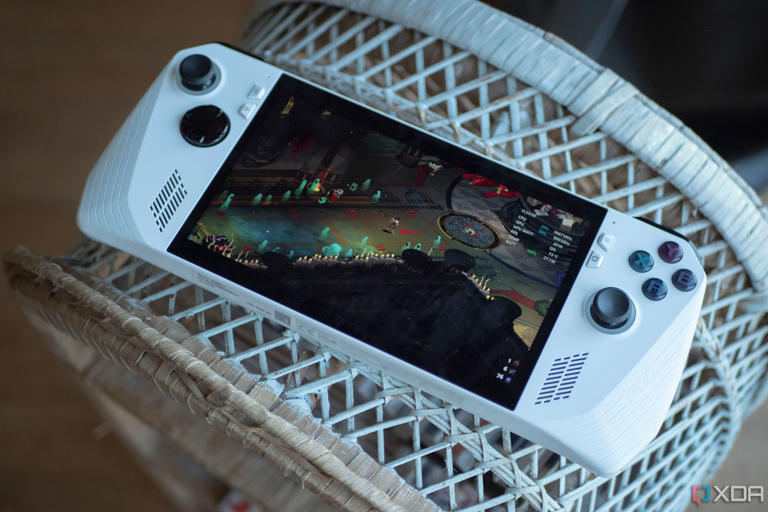
What you need to get started
Technically, nothing but more accessories make the experience better
If you have a gaming handheld, you already have a portable computer. Devices like the ROG Ally, Lenovo Legion Go, and MSI Claw run Windows, and others such as the Steam Deck run Linux but still have a desktop mode. That, plus a touchscreen, means that you could use a PC gaming handheld as a laptop without needing anything else. We don't recommend this due to how frustrating it can be to use a desktop OS on a touchscreen, and how awkward it can be to type on a PC gaming handheld screen. To get the best experience, you'll need a few accessories that'll help turn a handheld into a laptop.
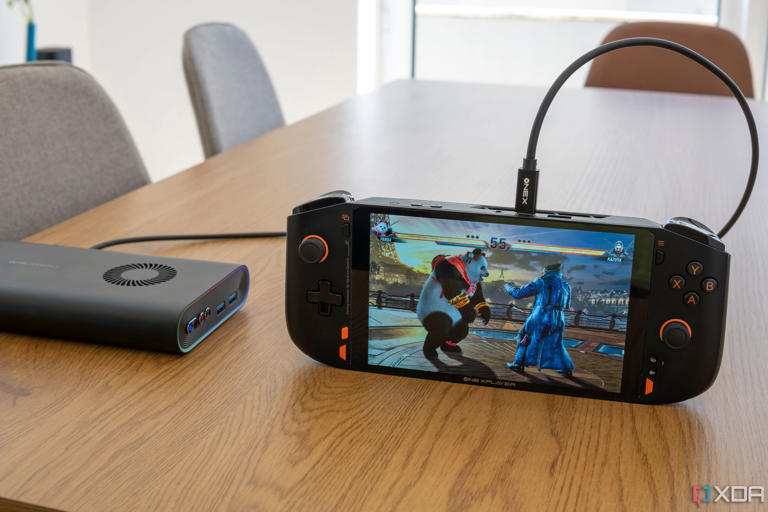
Luckily, you don't need an eGPU to make your gaming handheld a serviceable laptop replacement. The internal components are more than good enough for most tasks, especially web-based ones. If they handle PC-class gaming, they'll be able to crush most tasks that would be typically handled by a laptop. Additionally, a portable monitor is lower on the list of recommended accessories than you might expect. Sure, it's nice to have a bigger screen, but I'd want a mouse, keyboard, and USB hub before a portable monitor while using my ROG Ally as a laptop. To create my laptop-killer setup with the ROG Ally as the centerpiece, I paired it with the Lofree Edge keyboard, a Logitech MX Master 3S mouse, a Ugreen docking station, a 145W power bank, and an Acer SpatialLabs portable monitor.
Using a gaming handheld's built-in display
It's small, but your handheld's inbuilt screen will get the job done
Chances are, you may have all the accessories needed to put together a portable PC gaming handheld except one: a portable monitor. Some digital nomads and remote workers swear by portable monitors for on-the-go work, but they're still a very niche category. That's why we tested using a gaming handheld's built-in display for use in place of a laptop. There are two main benefits that come with using a device like the ROG Ally without a bigger display. For starters, you'll get better battery life and may not even need a battery pack, because the handheld is optimized for its inbuilt display. Additionally, you won't need a USB hub if you want to connect peripherals to your handheld over Bluetooth.
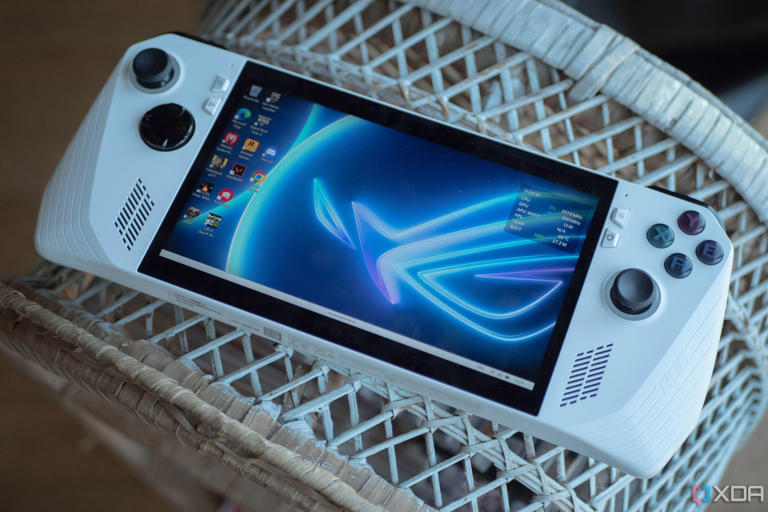
I used a PC gaming handheld on the go, and I didn't miss my laptop
Compared to other options, like a tablet or folding phone, a gaming handheld is better than you might expect and you might not need a laptop.To use this method, simply pick out a compact Bluetooth keyboard and mouse and connect them to your PC gaming handheld. The smaller they are, the better, because the goal is to keep this setup as portable as possible. If your handheld device doesn't feature a built-in kickstand — the Lenovo Legion Go does, for example — you can find a case or accessory that adds that functionality. After pairing the peripherals in your handheld's settings app, you're all set to start using the device as a laptop replacement. However, I found myself squinting a lot on my ROG Ally's tiny screen, and you can fix that problem by picking up a portable monitor.
 : Laptop makers try dual screens, foldables and DIY upgrades (KTLA-TV Los Angeles)

Pair a portable monitor for the best experience
With a full-size monitor, you aren't missing out by using a handheld
There is a no-compromises portable setup you can create with a PC gaming handheld, and it includes the following products:
- PC gaming handheld
- High-capacity power bank
- USB-C hub or docking station
- Compact Bluetooth keyboard and mouse
- Portable monitor
With these six devices and accessories, you'll get everything you would typically expect out of a laptop and more. The docking station I paired with my ROG Ally made it possible to connect to the Acer SpatialLabs while adding more ports for passthrough charging and connecting to USB accessories. Since that SpatialLabs monitor has a built-in battery that can last up to five hours, there wasn't a massive hit to my handheld's battery life. If you can find a portable monitor that has a built-in battery (and ideally costs less than the pricey SpatialLabs one), we absolutely recommend buying it. Plus, when connecting a portable monitor, you'll still get the option of extending your handheld's inbuilt screen — turning into what is effectively a dual-screen laptop.

PC gaming handhelds are typically priced at around $700, but you can find them for less than that during occasional sales. It's impresive that these computing devices offer so much power and versatility at that price point. If you're buying a PC gaming handheld, it should be for handheld gaming first and foremost. But make no mistake, you can certainly use a handheld as a laptop or desktop replacement with the right accessories.


